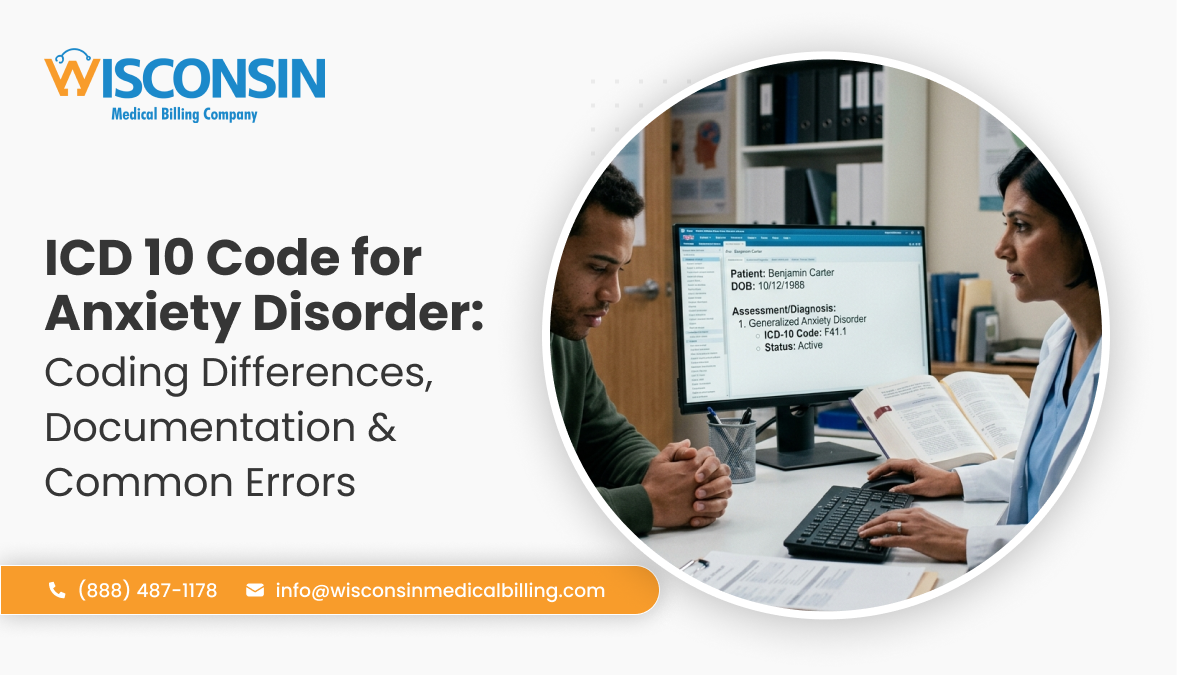
Anxiety disorders are frequently treated in primary care, behavioral health, psychiatry, and other clinical settings. Although anxiety symptoms may appear similar across patients, the diagnosis and the appropriate ICD 10 code for anxiety disorder can vary based on the provider’s clinical assessment and documentation.
Getting the diagnosis codes right is very important because the ICD-10-CM code is the ailment being treated on the medical claim. Choosing a wrong or broad code may result in documentation errors, delayed or denied claims. Providers and coders should be aware of the distinctions between anxiety diagnoses and select codes supported by the medical record.
In this tutorial we’ll examine frequent anxiety ICD 10 codes, documentation considerations, coding variations, common mistakes, and where appropriate diagnosis coding fits into the mental health billing process.
What Is the ICD 10 Code for Anxiety Disorder?
There is no single ICD-10-CM code for every anxiety disorder. The correct code depends on the specific diagnosis documented by the provider.
Common anxiety-related codes include:
- F41.0 — panic disorder [episodic paroxysmal anxiety]
- F41.1 — Generalized anxiety disorder
- F41.2 — Mixed anxiety and depressive disorder
- F41.3 — Other mixed anxiety disorders
- F41.8 — Other specified anxiety disorders
- F41.9 — Anxiety disorder, unspecified
- F40.00 — Agoraphobia, unspecified
- F40.01 — Agoraphobia with panic disorder
- F40.10 — Social phobia, unspecified
- F40.11 — Social phobia, generalized
The correct anxiety diagnosis code should reflect the provider’s documented diagnosis.
Don’t choose a more specific ailment just because the patient seems to have the signs and symptoms of that condition.
Understanding Common Anxiety ICD 10 Codes
Different anxiety ICD 10 codes are different clinical disorders. Knowing the differences helps physicians and coders steer away from using a code simply because the term “anxiety” is written somewhere in a medical record.
F41.1: Generalized Anxiety Disorder
F41.1 represents generalized anxiety disorder. This diagnosis should be supported by the provider’s clinical assessment and documentation.
Providers may document persistent or excessive anxiety and worry as part of the clinical picture, along with relevant symptoms and functional impact. The final diagnosis should come from the provider rather than being inferred by the coder.
F41.9: Anxiety Disorder, Unspecified
F41.9 is anxiety disorder, undefined. It may be suitable when the physician documents an anxiety problem but does not develop a more detailed anxiety diagnosis.
An unspecified code, should not be assumed to be incorrect automatically. It may be suitable when the existing clinical documentation does not support greater specificity.
F41.0: Panic Disorder
F41.0 represents panic disorder. It should be reported when the provider has documented panic disorder and the clinical record supports that diagnosis.
Panic symptoms alone do not automatically mean that F41.0 is appropriate. The diagnosis reported should match the provider’s assessment.
F40 Codes: Phobic Anxiety Disorders
The F40 category includes various phobic anxiety disorders, such as agoraphobia and social phobia.
These codes show why a search for the term “anxiety” is not adequate. The coder needs to understand the documented diagnosis and choose the code that fits the documented diagnosis.
How to Choose the Correct ICD 10 Code for Anxiety Disorder
Selecting the correct ICD 10 code for anxiety disorder starts with the provider’s documentation.
Coders should follow the ICD-10-CM Official Guidelines for Coding and Reporting when reviewing documentation, selecting diagnosis codes, and determining the appropriate level of specificity.
Review the Provider’s Diagnosis
The coder should first identify the diagnosis explicitly documented by the provider. Symptoms, screening results, or medication use should not be used alone to assign a specific anxiety disorder diagnosis.
Determine Whether the Disorder Is Specific
When a specific ailment is documented by the provider, such as generalized anxiety disorder, panic disorder, social phobia, or other, and supported by the record, code accordingly.
If the provider documents simply an unidentified anxiety problem, F41.9 may be appropriate.
Review Supporting Clinical Information
The medical record should contain information that supports the diagnosis being treated. Relevant symptoms, clinical findings, treatment decisions, and follow-up plans can help establish the clinical context.
Avoid Guessing
Coders should never diagnose the patient based on documentation. Their role is to accurately report the provider’s documented diagnosis according to applicable coding rules.
For practices that need additional support with diagnosis selection and claim preparation, professional medical coding services can help establish a consistent coding workflow.
Anxiety Disorder Documentation Requirements
Good documentation is the foundation of accurate anxiety diagnosis coding.
Providers should document the clinical information necessary to explain the patient’s condition and treatment. Depending on the encounter, this may include:
- The diagnosed anxiety disorder
- Relevant symptoms and clinical findings
- Severity or clinical status when applicable
- Impact on daily functioning when clinically relevant
- Treatment provided
- Medication management when applicable
- Psychotherapy or counseling services
- Patient response to treatment
- Changes in symptoms
- Follow-up recommendations
Documentation should represent the patient’s true clinical condition, rather than duplicating a prior diagnosis into every meeting.
Clear documentation is also key to mental health billing services as the diagnosis, services performed and medical necessity should all be consistent across the claim.
Coding Differences Between Anxiety Disorders
One of the most important things to understand about coding for anxiety is that comparable symptoms might be associated with distinct illnesses.
For instance, generalized anxiety disorder and panic disorder are not the same . Likewise, a specific phobic disorder should not be immediately labelled as undefined anxiety just because there are anxious symptoms present.
This distinction is especially essential when a provider has documented a specific diagnosis.
Specific vs. Unspecified Anxiety
The difference between specific and unspecified coding is primarily driven by documentation.
If the provider clearly establishes a specific anxiety disorder, the corresponding code may be appropriate. If the provider documents anxiety disorder without additional diagnostic specificity, F41.9 may be appropriate.
Anxiety vs. Mixed Anxiety and Depression
Some patients may have both anxiety and depressive symptoms. However, the presence of symptoms does not automatically support F41.2. The provider must document the applicable diagnosis.
Anxiety vs. Panic Disorder
Panic symptoms may occur in several clinical situations. A coder should not automatically assign F41.0 unless the provider has documented panic disorder.
Common Anxiety Coding Errors
Coding errors can create unnecessary claim work and may affect reimbursement. Understanding common problems can help providers improve documentation before claims are submitted.
Using F41.9 for Every Anxiety Diagnosis
F41.9 is not a universal code for anxiety. When a specific diagnosis is documented and supported, the applicable specific code should be considered.
Coding From Symptoms Alone
Symptoms such as nervousness, worry, fear, or panic do not automatically establish a specific anxiety disorder.
The provider’s documented diagnosis should guide code selection.
Confusing Generalized Anxiety With Panic Disorder
F41.1 and F41.0 represent different diagnoses. Coders should review the provider’s assessment rather than selecting a code based on individual symptoms.
Selecting a Code Without Documentation Support
A highly specific code should have documentation that supports the diagnosis. When the record does not support the specificity, the claim may become vulnerable to review.
Carrying Forward Outdated Diagnoses
A diagnosis from a previous visit should not automatically be carried forward without considering the current clinical documentation. Providers should update the record when the patient’s condition or diagnosis changes.
How Anxiety Coding Affects Behavioral Health Claims
Diagnosis coding is one part of the overall behavioral health claim. A claim may also include procedure codes, provider information, patient information, payer details, authorization information, and other required elements.
An incorrect anxiety diagnosis code can create problems when it conflicts with the documented service or other information on the claim.
For example, a claim may require additional attention when:
- The diagnosis does not support the documented service.
- The diagnosis code is incorrect.
- Documentation does not support the reported diagnosis.
- Authorization requirements were not satisfied.
- Provider information is incomplete.
- Eligibility information is inaccurate.
- Payer-specific requirements were overlooked.
Wisconsin Medical Billing’s mental health billing service specifically addresses behavioral health challenges such as time-based coding, medical necessity documentation, prior authorization, claim submission, and denial management.
For Medicare-related behavioral health billing, providers and billing teams can also review CMS Psychiatry and Psychology Services billing and coding guidance for applicable coding and claim requirements.
CLAIM REVIEW
One Diagnosis Code Is Part of the Bigger Claim
A clean behavioral health claim requires several pieces to align.
Anxiety Coding and Medical Necessity
Accurate diagnosis coding can help communicate the clinical reason for a service. However, the diagnosis code should never be selected simply because it is expected to support payment.
The medical record should explain the patient’s condition and the services provided. The diagnosis, clinical findings, treatment plan, and billed services should tell a consistent story.
This is especially important for ongoing behavioral health treatment. Providers should document changes in symptoms, treatment response, and clinical needs as appropriate rather than relying on identical documentation from one visit to the next.
A consistent documentation process can support accurate behavioral health coding services and reduce avoidable claim questions.
How to Reduce Anxiety Coding Errors
A structured coding process can help practices improve accuracy.
Review Documentation Before Coding
Review the relevant clinical documentation before assigning the diagnosis code. Avoid relying only on an old problem-list entry.
Match the Code to the Diagnosis
The selected code should correspond to the provider’s documented diagnosis. Do not substitute a more specific diagnosis based on assumptions.
Check Code Specificity
Determine whether the documentation supports a specific anxiety disorder or whether an unspecified code is appropriate.
Review Payer Requirements
Payer policies may include specific documentation, authorization, or billing requirements. Practices should keep their workflows current.
Perform Regular Coding Audits
Periodic audits can identify recurring errors and help practices determine whether additional provider education or coding review is needed.
Wisconsin Medical Billing offers medical billing services that include coding compliance reviews designed to identify CPT, ICD-10, and HCPCS coding issues.
Anxiety Billing: What Providers Should Review
When submitting an anxiety related claim, physicians and billing teams need to view the entire claim, not just the diagnosis code.
A useful checklist includes:
- Patient demographics
- Insurance eligibility
- Provider information
- Diagnosis codes
- Procedure codes
- Modifiers when applicable
- Authorization requirements
- Clinical documentation
- Payer-specific requirements
- Timely filing requirements
Accurate coding combined with effective claim review can help reduce avoidable rejections and improve the consistency of the billing process.
Wisconsin Medical Billing provides medical billing services that include claim handling, payment processing, and denial-related support for healthcare practices.
When Should Mental Health Practices Consider Outsourcing Coding?
As behavioral health practices grow, coding and billing can become increasingly difficult to manage internally.
Practices may consider mental health coding services when they experience:
- Increasing claim volume
- Repeated coding errors
- Frequent denials
- Limited billing staff
- Difficulty keeping coding knowledge current
- Growing accounts receivable
- Multiple providers or locations
- Complex payer requirements
Outsourcing can give practices access to trained coding and billing professionals without requiring them to build a larger internal department.
Wisconsin Medical Billing states that its coding team works with ICD-10 and CPT coding and provides coding support designed to reduce coding-related claim problems.
Anxiety Billing and Provider Credentialing
Coding accuracy is important, but provider enrollment can also affect whether claims are processed correctly.
Credentialing and payer enrolment information should be updated when a behavioral health provider joins a practice, moves to a new location or takes part with more insurance plans.
If the provider information is not current or is incomplete, the claim may be delayed even if the diagnosis and procedure codes are correct.
Professional medical credentialing services can aid practices with payer enrolment, revalidation, CAQH information, and other administrative procedures.
Wisconsin Medical Billing’s credentialing service includes Medicare and Medicaid enrollment, commercial payer credentialing, NPI setup, revalidation, state license support, and CAQH profile management.
How to Improve the Anxiety Billing Workflow
A reliable billing workflow connects documentation, coding, claim submission, payment posting, and denial follow-up.
The process should begin with accurate patient and insurance information. Providers then document the diagnosis and services clearly. Coders read the documentation and assign appropriate ICD-10-CM and CPT codes.
Before submission, the billing team can evaluate the claim for coding, authorization, eligibility and payer-specific concerns. After submission, payment posting and accounts receivable follow-up help identify unpaid claims.
If a claim is refused the team should find out why it was denied (not just submit the same claim again).
To learn more about systematic denial prevention, read 5 Data-Driven Denial Management Strategies for 2026, and learn about root-cause analysis, claim patterns, payer behavior, clean-claim monitoring and staff training.
Practices can also check out the CMS Interoperability & Prior Authorization Final Rule for details on recent federal prior authorization rules that may impact billing procedures.
When to Seek Professional Medical Coding Support
Professional coding support can be useful when a practice lacks internal coding expertise or regularly encounters claim problems.
A skilled coding team can analyze clinical paperwork, spot anomalies in coding, monitor revisions and help to develop consistent practices.
This support might be particularly helpful for behavioral health clinics that provide psychotherapy, psychiatric treatments, counselling, medication management or multiple types of mental health care.
Wisconsin Medical Billing provides coding support across specialties and states that its coders work with current ICD-10 and CPT standards.
Conclusion
Choosing the correct ICD 10 code for anxiety disorder requires more than finding the word “anxiety” in a patient’s chart. Providers and coders need to comprehend the diagnosis documented and be able to differentiate between generalized anxiety disorder, panic disorder, phobic anxiety disorders, mixed anxiety and depressive disorder, and nonspecific anxiety.
F41.1 and F41.9 are essential codes however they are not the only anxiety-related ICD-10-CM codes. The correct code depends on the diagnosis as documented by the physician and coding rules applicable.
Behavioral health practices can achieve a more predictable revenue cycle through accurate documentation, consistent coding review, claim verification and effective denial follow-up.
For practices that need more assistance, specialized behavioral health billing services can combine coding, claims, authorizations, payment posting and rejection management into one workflow.
Frequently Asked Questions:
What is the ICD 10 code for anxiety disorder?
There are many ICD-10-CM codes for anxiety disorders. F41.1 Generalized anxiety disorder F41.9 anxiety disorder, nonspecific other codes are for panic disorder, mixed anxiety disorders, and phobic anxiety disorders.
What is F41.1?
F41.1 is the ICD-10-CM code for generalized anxiety disorder. The provider’s documentation should support the diagnosis before the code is assigned.
What is F41.9?
F41.9 represents anxiety disorder, unspecified. It may be appropriate when the provider documents an anxiety disorder but does not establish a more specific diagnosis.
Is F41.1 the same as F41.9?
No. F41.1 represents generalized anxiety disorder, while F41.9 represents anxiety disorder, unspecified. They should not be treated as interchangeable codes.
Can anxiety coding errors cause claim denials?
Yes. Incorrect diagnosis coding, unsupported specificity, documentation gaps, authorization problems, and other claim issues can contribute to denials or payment delays.
Why is documentation important for anxiety coding?
Documentation provides the clinical basis for the diagnosis reported on the claim. Clear documentation helps coders select a code that accurately reflects the provider’s assessment.
Can anxiety billing be outsourced?
Yes. Practices can outsource revenue cycle tasks such as medical coding, claim filing, eligibility verification, authorization management, denial follow-up, and more. You don’t have to do it all in-house. Outsourcing can enable you to tap into specialized mental health billing services.