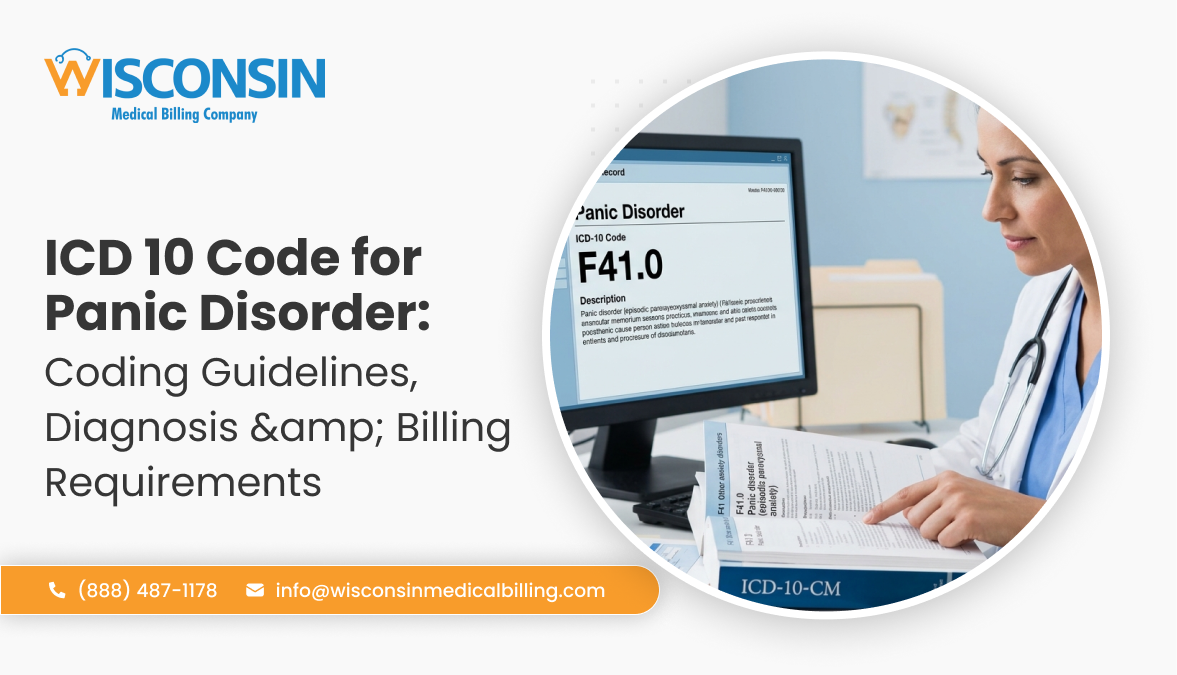
Panic disorder is a behavioral health condition that can involve recurrent, unexpected panic attacks and significant concern about additional attacks or their effects. For healthcare providers, documenting the condition clearly is essential because the diagnosis must support the ICD-10-CM code reported on the claim.
The ICD 10 code for panic disorder is F41.0. However, panic-related disorders may be coded differently based on the recorded diagnosis by the clinician. F40.01 is agoraphobia with panic disorder. E.g. F41.1 is generalized anxiety disorder.
The diagnosis code presently in a place for the panic disorder is not only enough to properly classify it. Providers and billing staff can examine the clinical record, determine panic disorder from the other anxiety disorders, choose the correct ICD-10-CM code and give documentation so that the diagnosis is reimbursable for the behavioral health care.
Today’s post will review the ICD 10 code for panic disorder, diagnoses that are similar, documentation, billing, and a few of coding errors that can lead to claim denials.
What Is the ICD 10 Code for Panic Disorder?
The primary ICD 10 code for panic disorder is F41.0.
F41.0 – Panic disorder [episodic paroxysmal anxiety]
The designation is for the F41 group of various anxiety disorders. ICD-10-CM classifies panic disorder as recurring panic attacks, rather than anxiety related to a specific event.
Reporting of F41.0 must be supported by the provider’s diagnosis in the medical record. A single panic episode or occasional anxiety doesn’t necessarily mean the patient has panic disorder. The diagnosis shall be made by the treating clinician based on his or her clinical judgement and documentation.
Providers and coding professionals can also use the CDC’s ICD-10-CM Classification of Diseases resources to review the current U.S. diagnosis coding system and access official ICD-10-CM code resources.
This distinction is important to billing teams since the diagnosis code should be based on the condition noted in the record and not a code determined purely on the basis of reported symptoms.
Panic Disorder ICD 10 Code at a Glance
| ICD-10-CM Code | Description |
| F41.0 | Panic disorder [episodic paroxysmal anxiety] |
| F40.01 | Agoraphobia with panic disorder |
| F40.02 | Agoraphobia without panic disorder |
| F41.1 | Generalized anxiety disorder |
| F41.8 | Other specified anxiety disorders |
| F41.9 | Anxiety disorder, unspecified |
CMS lists these diagnoses among the psychiatric and anxiety-related codes used for behavioral health billing.
QUICK CODE GUIDE
Panic & Anxiety Diagnosis Map
🔍
PRIMARY CODE
F41.0
Panic disorder [episodic paroxysmal anxiety]
RELATED CODE
F40.01
Agoraphobia with panic disorder
RELATED CODE
F41.1
Generalized anxiety disorder
RELATED CODE
F41.8
Other specified anxiety disorders
RELATED CODE
F41.9
Anxiety disorder, unspecified
RELATED CODE
F40.02
Agoraphobia without panic disorder
ⓘ Coding note:
The appropriate diagnosis should be supported by the provider’s documentation rather than selected from symptoms alone.
The appropriate diagnosis should be supported by the provider’s documentation rather than selected from symptoms alone.
How Panic Disorder Differs from a Panic Attack
A key coding criterion for panic disorder is the differentiation between the clinical diagnosis of panic disorder and a single panic episode.
Panic attacks are short but intense periods of worry or discomfort associated with a number of uncomfortable physical symptoms include rapid heartbeat, chest pain, dizziness, shortness of breath, trembling or feeling of losing control. A panic attack by itself does not equal panic disorder.
Thus, in such a case, the diagnosis of F41.0 should not be used as a default setting every time a patient has an isolated panic episode.
The medical record should document the provider’s assessment and diagnosis. If the provider has diagnosed panic disorder the paperwork must support that diagnosis and the treatment plan.
This distinction also helps prevent confusion with other anxiety diagnoses. Practices can review our related guide on ICD 10 Code for Anxiety Disorder for additional information about differentiating anxiety diagnoses and documentation requirements.
Related ICD-10 Codes for Panic and Anxiety Conditions
Panic symptoms can appear in several behavioral health conditions, so selecting the correct diagnosis requires attention to the provider’s documented assessment.
F41.0 – Panic Disorder
Use F41.0 when the provider documents panic disorder and the clinical record supports the diagnosis.
This is the primary answer to the search query “panic disorder ICD 10” and “ICD 10 code for panic disorder.”
F40.01 – Agoraphobia with Panic Disorder
F40.01 Agoraphobia with panic disorder. Not to be confused with F41.0.
If the provider has recorded agoraphobia with panic disorder, the record must support the reported condition before assigning the code.
F41.1 – Generalized Anxiety Disorder
F41.1 represents generalized anxiety disorder. It is different from panic disorder and should not be selected simply because a patient experiences anxiety alongside panic symptoms.
F41.8 – Other Specified Anxiety Disorders
F41.8 can apply when the provider documents another specified anxiety disorder that does not fit the more specific available categories.
F41.9 – Anxiety Disorder, Unspecified
F41.9 represents anxiety disorder, unspecified. It should not replace F41.0 when the provider has clearly documented panic disorder.
Using the most specific supported diagnosis helps improve coding accuracy and reduces unnecessary claim questions.
Documentation Requirements for Panic Disorder Coding
Good clinical documentation is the foundation of accurate panic disorder ICD 10 coding. The diagnosis should be supported by the provider’s assessment rather than inferred by the coder from isolated symptoms.
A useful record may include:
- Documented diagnosis of panic disorder when clinically established
- Description of relevant symptoms and clinical findings
- History or frequency of panic episodes when clinically relevant
- Assessment of related anxiety symptoms
- Documentation of functional impact when relevant
- Treatment recommendations or interventions
- Medication management when applicable
- Follow-up plan
- Relevant differential diagnosis when clinically necessary
The physician must also identify panic disorder from other diseases where the differentiation influences diagnosis decisions.
For example, if the patient has panic and agoraphobia, the record should reflect the clinical correlation. This gives the coding team enough information to select the appropriate diagnosis rather than guessing.
Accurate diagnosis coding depends on complete provider documentation and the applicable ICD-10-CM guidelines. Providers and coding teams can review the ICD-10-CM Official Guidelines for Coding and Reporting for federal coding guidance.
Panic Disorder Billing Requirements for Providers
Correct diagnosis coding is only one part of successful behavioral health billing. The diagnosis must also connect logically with the service reported.
Behavioral health treatments may include psychiatric diagnostic examination, psychotherapy, medication management, or other covered services, depending on the interaction. CMS provides billing and coding instructions for mental diagnostic examination and psychotherapy services, including diagnosis codes such as F41.0.
Match the Diagnosis to the Service
The diagnosis should support the medical necessity of the service being billed.
For example, if a provider performs psychotherapy for a documented panic disorder, the claim should contain the appropriate procedure code and a supported diagnosis code.
The diagnosis alone does not determine which CPT code should be reported. CPT selection depends on the actual service provided, documentation, provider type, time or service requirements, and payer rules.
Check Payer Requirements
Commercial insurers, Medicare, Medicaid, and other payers may have different behavioral health billing policies.
Before submitting a claim, billing teams should verify:
- Patient eligibility
- Behavioral health benefits
- Authorization requirements
- Covered services
- CPT requirements
- Diagnosis requirements
- Telehealth rules when applicable
- Provider enrollment status
- Timely filing limits
This is particularly important for practices that provide recurring behavioral health treatment.
For Wisconsin practices needing support with these processes, Mental Health Billing Services can be linked here.
CPT Coding Considerations for Panic Disorder
The diagnosis code F41.0 identifies the patient’s condition; it does not identify the psychotherapy or psychiatric service performed.
Behavioral health providers may report different CPT codes depending on the service. Sample psychotherapy codes are 90832, 90834, and 90837. When the right criteria are met, the Psychiatric Diagnostic Evaluation can be billed at 90791 or 90792.
The right CPT code depends on the actual service, paperwork, provider qualifications and payer criteria.
Billing teams should avoid selecting a CPT code based solely on the diagnosis. A panic disorder diagnosis can support different types of behavioral health services depending on what occurred during the encounter.
This is one reason accurate medical coding services are valuable for practices handling high volumes of behavioral health claims.
Common Panic Disorder Coding Errors
Even when F41.0 is familiar to the billing team, several errors can affect claims.
Coding Symptoms Instead of the Documented Diagnosis
The coder may opt to code for symptoms like dizziness, palpitations or shortness of breath instead of the stated diagnosis by the clinician.
Code to the diagnosis as reported if the provider diagnosed panic disorder, following ICD-10-CM guidelines.
Confusing Panic Disorder with Generalized Anxiety Disorder
F41.0 and F41.1 are separate diagnoses.
If you code F41.1 just because the note mentions anxiety, you will be coding incorrectly when the provider has documented panic disorder.
Confusing Panic Disorder with Agoraphobia with Panic Disorder
F40.01 and F41.0 should not be used interchangeably. Whether agoraphobia is present as part of the diagnosis should be determined by the documentation of the provider.
Using an Unspecified Code Without Need
If the provider documents an unidentified anxiety problem you can use F41.9. However, it is not intended to be used in place of a more precise diagnosis that is properly documented.
Reporting a Diagnosis Not Supported by Documentation
Symptoms alone don’t mean someone has a psychiatric disorder. If the material does not support the diagnosis, the process may be a provider query per organizational rules and applicable coding guidelines.
Ignoring Payer-Specific Requirements
Correct coding of F41.0 does not guarantee payment. Eligibility, authorization, choice of CPT codes, documentation, provider enrolment and payer-specific regulations for coverage all affect reimbursement.
How to Reduce Panic Disorder Claim Denials
A strong claim-review process can identify errors before they become costly rework.
Start with documentation. Confirm that the diagnosis is clearly stated and supported by the clinical record.
Next, verify the patient’s insurance coverage and behavioral health benefits. Verify if authorization is needed and if the provider is correctly enrolled with the payer.
Next, compare the CPT and ICD-10-CM codes, side by side. Diagnosis should support the service offered and procedure code should appropriately reflect the documented encounter.
Finally, review rejected and denied claims for recurring patterns.
Common issues may include:
- Incorrect diagnosis selection
- Missing documentation
- Invalid or incomplete coding
- Authorization problems
- Eligibility issues
- Incorrect CPT selection
- Provider enrollment problems
- Payer-specific billing requirements
A dedicated medical billing services process can help practices handle claim submission, payment posting, follow-up and rejection resolution.
When Credentialing Affects Behavioral Health Billing
Provider enrollment and credentialing can directly affect whether claims process successfully.
If a behavioral health provider joins a new practice, changes locations, adds payer contracts, or begins participating with additional insurance plans, credentialing information needs to remain accurate and current.
Incorrect provider information can result in claim rejections or payment delays even when the ICD-10-CM and CPT codes are correct.
Practices expanding behavioral health services can therefore benefit from dedicated medical credentialing services that support payer enrollment and provider information management.
A Practical Panic Disorder Coding Workflow
A simple workflow can help billing teams maintain consistency:
Step 1: Review the provider’s assessment.
Identify the diagnosis actually documented by the treating provider.
Step 2: Confirm the diagnosis category.
Decide whether the documentation supports the diagnosis of panic disorder, generalized anxiety disorder, agoraphobia with panic disorder, or something else.
Step 3: Select the ICD-10-CM code.
For documented panic disorder, the appropriate code is F41.0.
Step 4: Review the service performed.
Make sure the CPT code corresponds to the actual psychiatric or psychotherapy service provided.
Step 5: Verify payer requirements.
Determine eligibility, benefits, authorization, provider enrolment, and payer policies that apply.
Step 6: Scrub the claim.
Review diagnosis, CPT, modifiers, provider information, and other required claim elements.
Step 7: Track payment and denials.
Track unpaid claims and find patterns. Identify grounds for denial.
The workflow is designed to unify clinical documentation, coding, billing and reimbursement, and not to function as separate entities.
How Medical Billing Support Can Help Mental Health Practices
Behavioral health practices often manage detailed documentation, time-based services, payer requirements, authorizations, and recurring claims. A billing process designed specifically for mental health services can help reduce administrative pressure.
Wisconsin Medical Billing’s mental health billing service addresses areas such as claims submission, coding, prior authorization management, denial management, payment posting, and credentialing.
For practices that need broader physician-focused revenue cycle support, Physician Billing Services is another relevant internal resource.
Final Takeaway
Accurate ICD 10 coding for panic disorder depends on detailed clinical documentation. The real ICD-10-CM code for this condition is F41.0 (panic disorder). Panic disorder, generalized anxiety disorder and nonspecific anxiety disorder should not be used as a substitute for related conditions such as agoraphobia. These conditions use separate codes and require documentation support.
Practices must link to the diagnosis which is appropriate service, check the payer criteria, maintain a proper provider enrolment, and examine the claims for a coding and for the paperwork errors to guarantee a successful reimbursement.
When ICD-10-CM updates are available, billing teams must verify the code set is correct for the date of service or not. CDC notes, “The applicable coding periods are determined by the ICD-10-CM fiscal-year releases. “FY2026 is for services through September 30, 2026 and FY2027 starts October 1, 2026.”
A well-organized revenue cycle plan can help Wisconsin behavioral health providers guarantee mental health billing and coding services are accurate, organized and meet payer criteria.
Frequently Asked Questions
What is the ICD 10 code for panic disorder?
The ICD 10 code for panic disorder is F41.0 – Panic disorder [episodic paroxysmal anxiety].
What is the ICD 10 code for panic attacks?
A panic attack can occur in different clinical contexts, so providers should document the diagnosis rather than automatically assigning a panic disorder code. When the provider diagnoses panic disorder, F41.0 is the applicable ICD-10-CM code.
Is F41.0 the same as agoraphobia with panic disorder?
No. F41.0 represents panic disorder, while F40.01 represents agoraphobia with panic disorder.
Can F41.0 be used for psychotherapy billing?
F41.0 can be reported as a diagnosis supporting applicable behavioral health services when the provider documents panic disorder and the service meets the payer’s coverage and documentation requirements. CPT selection must reflect the actual service performed.
Should coders assign F41.0 from symptoms alone?
No. Coders should base diagnosis coding on the provider’s documented diagnosis and applicable ICD-10-CM coding guidelines rather than independently diagnosing the patient.