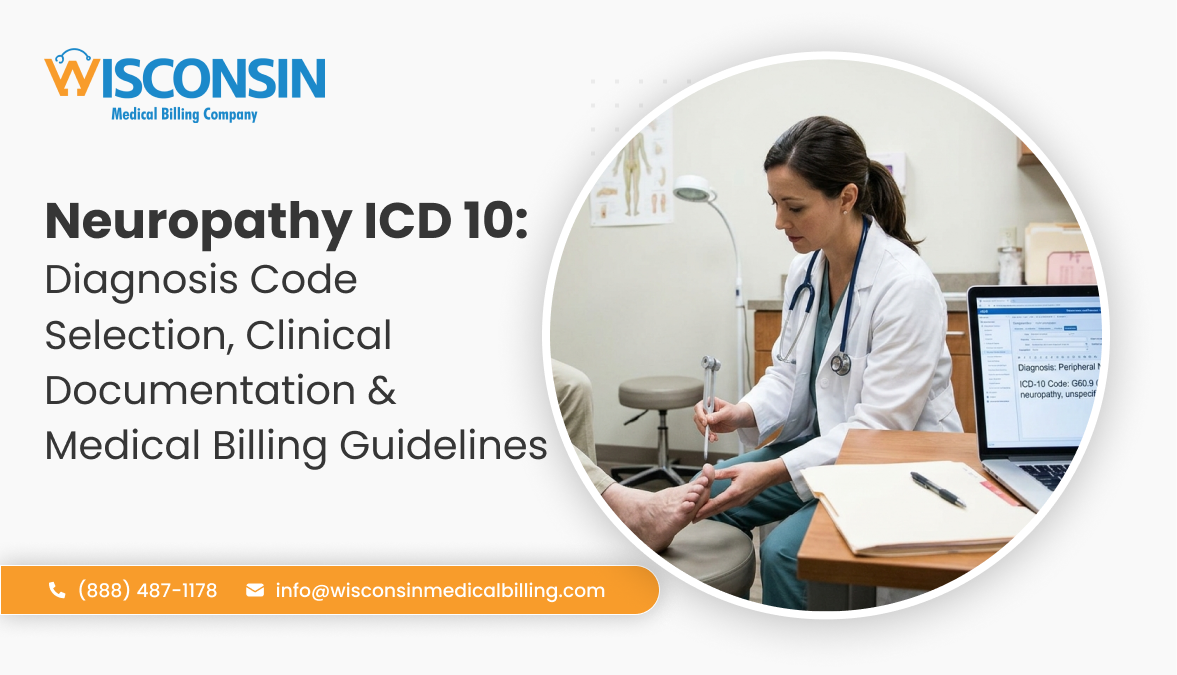
Neuropathy is a neurological disease that can impact sensation, mobility, and balance. To assign the correct Neuropathy ICD 10 code, providers should perform an accurate diagnosis, conduct appropriate clinical documentation, and understand the underlying causes of the disease.
Diabetes, medications, nutritional deficits, inherited diseases and other factors can result in Neuropathy. Physicians are required to distinguish various forms of Neuropathy for an accurate coding diagnosis.
ICD-10-CM coding is used to assist physicians, neurologists, and other primary care physicians and clinicians in identifying medical necessity and filing claims. Your practice can simplify your revenue cycle by auditing the coding process and outsourcing to Wisconsin professional medical billing companies to handle your internal resources.
This guide reviews the ICD-10-CM codes for neuropathy, documentation and coding guidance and billing best practices to help physicians with accurate medical record keeping and to decrease claim rejections or denied claims.
Providers and medical coders can consult the official ICD-10-CM coding guidelines to verify diagnosis codes and follow applicable coding instructions.
NEUROLOGY EXPLAINED
Neuropathy: Look Beyond the Symptoms
Nerve dysfunction can affect how the body senses, moves, and responds to its surroundings.
〰️
Sensation
Tingling, burning, or reduced feeling
💪
Movement
Weakness or reduced coordination
⚖️
Balance
Difficulty maintaining stability
Clinical reminder: Symptoms alone do not establish the specific neuropathy diagnosis. Follow the provider’s documented assessment.
What Is Neuropathy?
Neuropathy is a disease of nerve function and / or damage to one or more nerves. Peripheral neuropathy is neuropathy with damage to peripheral nerves. The peripheral nerves are those that are not part of the brain and spinal cord. These nerves may be in the feet and hands, in the arms or the legs.
Common symptoms include:
- Tingling, numbness, or burning sensations.
- Sharp, shooting, or nerve-related pain.
- Muscle weakness or reduced coordination.
- Increased sensitivity to touch.
- Balance difficulties and reduced sensation in the feet.
Diagnostic coding could depend on the source and form of the neuropathy. For example, the code for a diabetic polyneuropathy could be different from one with an unspecified etiology.
Tip: If you were told you have “symptom reports,” that doesn’t mean that you have a diagnosis of neuropathy. Paresthesia’s don’t require a diagnosis of neuropathy, either. The interaction should be substantiated by the medical record for the diagnosis provided.
Neuropathy ICD 10 Codes: Common Diagnosis Categories
The correct code is based on the provider’s documented diagnosis, known cause of the disease (if any) and any other coding instructions. Below is a table of the most common ICD-10-CM diagnosis codes for Neuropathy.
| ICD-10-CM code | Description |
| G62.9 | Polyneuropathy, unspecified |
| G62.89 | Other specified polyneuropathies |
| G62.0 | Drug-induced polyneuropathy |
| G60.9 | Hereditary and idiopathic neuropathy, unspecified |
| E11.40 | Type 2 diabetes mellitus with diabetic neuropathy, unspecified |
| E11.42 | Type 2 diabetes mellitus with diabetic polyneuropathy |
| E10.40 | Type 1 diabetes mellitus with diabetic neuropathy, unspecified |
| E10.42 | Type 1 diabetes mellitus with diabetic polyneuropathy |
| R20.2 | Paresthesia of skin |
ICD-10-CM QUICK REFERENCE
Match the Code to the Diagnosis
Start with the documented condition and its established cause. Never select a code based on symptoms alone.
UNSPECIFIED POLYNEUROPATHY
G62.9
Use only when the documented diagnosis supports this category.
DRUG-INDUCED POLYNEUROPATHY
G62.0
Verify documented medication-related causation and applicable instructions.
TYPE 2 DIABETIC POLYNEUROPATHY
E11.42
Confirm the documented diabetes type and neuropathy classification.
PARESTHESIA OF SKIN
R20.2
Represents a symptom, not a confirmed neuropathy diagnosis.
Before submitting: Check the current ICD-10-CM Alphabetic Index, Tabular List, code validity, and applicable coding guidelines.
Important Coding Distinction: G62.9 is polyneuropathy, unknown. Do not code this as a miscellaneous category for any type of neuropathy. Refer to the Alphabetic Index to ICD-10-CM, Tabular List and Alphabetic Index instructions to verify the code. R20.2 is a symptom and should not be used in lieu of a verified diagnosis of neuropathy if documented.
Use the appropriate FY 2027 ICD-10-CM code set for services performed on or after October 1, 2026. The most current code files and instructions can be found on the official CDC ICD-10-CM sites.
How to Select the Correct ICD 10 Code for Neuropathy
Selecting an ICD 10 code for neuropathy is more than just selecting a term from the chart. In addition to the disease, the provider, coders should also analyze the diagnosis, cause, clinical history, and coding instructions.
Identify the documented diagnosis
If you look at the assessment and plan, is there a note if the doctor told you that you had peripheral neuropathy, polyneuropathy, mononeuropathy or a different nerve disease? Please do not try to diagnose just based on symptoms. A drug reaction or test results alone.
Determine whether the cause is established
Indicate if the neuropathy is of etiology, specific condition e.g., diabetic or drug polyneuropathy – report to that category and instruction. The etiology of the neuropathy is unknown – report to this (i.e., INDETERMINATE) category, with documentation.
Check the level of specificity
If documentation is available, you will need to pick a more specific code. However, if the provider doesn’t document the problem, distribution and type of neuropathy, the coder should not make an educated guess.
Review the official coding instructions
Reader of the code must see the rules related to the inclusion, notes, sequencing instruction of the code. The reader must also ensure whether the code is valid for the date of service and type of facility.
A medical coding services can also help a practice review these figures on a regular basis when patients have a combination of illnesses.
Peripheral Neuropathy ICD 10: Coding Considerations
Peripheral neuropathy is a term used to describe any condition caused by a change in or damage to the peripheral nerve. Depending on the condition and cause of this disorder, select the appropriate ICD-10-CM code.
We report the condition with the code G62.9 for the polyneuropathy not specified; but this should not be used as the first listed code for any diagnosis of peripheral neuropathy. To ensure the accurate code, the Alphabetic Index and Tabular List should be referenced to identify the most relevant code for the physician’s diagnosis.
The clinical documentation should note the following information, when known:
- Which nerves or body regions are affected.
- Whether the condition involves sensory, motor, or multiple nerve functions.
- Whether the provider has established an underlying cause.
- Relevant examination findings and diagnostic test results.
- The assessment and treatment plan for the encounter.
Specifically, the coding teams are able to make the case that the condition is peripheral neuropathy, rather than a series of single symptoms or other types of neurologic conditions that have their own codes (such as radiculopathy).
Diabetic Neuropathy ICD 10: Type 1 and Type 2 Diabetes
Diabetes is an essential part of neuropathy. However, the existence of diabetes and nerve signs alone is not enough to diagnose diabetic neuropathy. The documentation of the provider has to be able to make the connection between the two ailments according to the coding instructions.
Type 2 diabetic neuropathy
Two commonly relevant codes are:
- E11.40: Type 2 diabetes mellitus with diabetic neuropathy, unspecified.
- E11.42: Type 2 diabetes mellitus with diabetic polyneuropathy.
E11.40 may apply when the provider documents diabetic neuropathy without specifying the type. E11.42 is more specific and applies when diabetic polyneuropathy is documented.
Type 1 diabetic neuropathy
Relevant codes include:
- E10.40: Type 1 diabetes mellitus with diabetic neuropathy, unspecified.
- E10.42: Type 1 diabetes mellitus with diabetic polyneuropathy.
The code should match the type of diabetes and diabetic neuropathy as documented; if polyneuropathy is not documented, there is no need to add a separate code.
Documentation and sequencing
Refer to the appropriate diabetic coding guidelines including any additional code needs. Determine if the record indicates a causal relationship and if any documented manifestations need to be revealed.
Providers should also capture relevant exam findings, progression of symptoms, treatment decisions, and the impact of the neuropathy on the patient’s plan of care. This information can assist with establishing medical necessity of services and aid in correct claims review.
For practices managing diabetic foot complications and related conditions, specialized podiatry billing services can help support accurate coding, medical necessity documentation, and claim submission.
Other Neuropathy ICD 10 Codes to Consider
Not all neuropathies are related to diabetes. There are also additional causes of neuropathy that need to be considered while evaluating the provider’s documentation and assigning the appropriate code.
Drug-induced polyneuropathy — G62.0
G62.0 Polyneuropathy due to medications. Consult the relevant coding guidelines to see whether there are any additional codes to be assigned for the particular drug or side effect.
Hereditary and idiopathic neuropathy — G60.9
G60.9 covers the spectrum of inherited and idiopathic neuropathies. This is not an unexplained polyneuropathy and should only be assigned if the reported diagnosis is within this group.
Other specified polyneuropathies — G62.89
G62.89 is used when the provider’s documentation indicates a diagnosis of other specified polyneuropathies but there is not a more specific code. Confirm this code is applicable using the Index and Tabular List.
Paresthesia — R20.2
R20.2 – Paresthesia: Use this code for tingling, burning, or other abnormal skin sensations when the provider documents these symptoms but has not established a more specific diagnosis. If documenting as a neuropathy, choose coding for the documented condition and according to report needs.
When a patient has separately documented behavioral health conditions, mental health billing services can help practices manage the associated diagnosis coding and payer requirements.
Clinical Documentation Requirements for Neuropathy Coding
Determining the correct code for neuropathy diagnosis requires comprehensive documentation from the provider’s records. It may be difficult to discriminate between an unexplained neuropathy, a cause-related code, and a general neurologic diagnosis.
The following should be recorded in the patient’s record by the healthcare professionals if applicable:
Patient symptoms and examination findings
Note the reported cues, symptoms, sites, duration, severity and frequency. Also, document the findings from the neurological assessment – change in sensation, the muscle strength, reflexes or coordination.
Underlying cause and associated conditions
Other documented cause or contributory circumstances, e.g. diabetes, exposure to medicines, known inherited disease. Never suggest a causal relationship if not indicated by the provider.
Internal medicine billing services can help practices manage claims involving multiple chronic conditions, diagnosis coding, and payer-specific documentation requirements
Diagnostic testing
Include findings from nerve conduction investigations, electromyography, laboratory testing or other diagnostic evaluation as appropriate. The test results should complement the clinical assessment and not replace the provider’s diagnosis.
Assessment and treatment plan
Diagnosis, clinical decision making, planned therapy, drug therapy, referral and follow-up are to be included in medical record as needed.
Medical necessity
The documentation should support the reasonableness and need of the services offered to the patient’s condition. The diagnosis on the claim must correspond to the service provided and the supporting record.
Consistent documentation methods help providers and coding teams clarify misunderstandings prior to submitting claims.
📋
RECORD QUALITY CHECK
Build a Stronger Neuropathy Record
A clear clinical record helps coding teams connect the provider’s assessment with the services reported on the claim.
1
Patient-reported concerns
Record symptom location, duration, frequency, severity, and functional impact.
2
Neurological examination
Include relevant findings on sensation, reflexes, muscle strength, and coordination.
3
Cause and supporting evidence
Document relevant conditions, medication exposure, test results, and established etiology when known.
4
Assessment and care plan
Connect the documented diagnosis to treatment decisions, follow-up, and the medical need for services.
Final review: Ensure the claim diagnosis agrees with the provider’s record and meets applicable coding and payer requirements.
Neuropathy Medical Billing Challenges and Claim Denials
Even when the right code is selected in documentation, medical billing problems can happen. Hence, physicians need to verify the correctness of the code used. There are many reasons that billing for neuropathy claims is complicated. Patients may have various diagnoses, chronic illnesses and courses of treatment. Claims may be refused for any of the following reasons:
- Incorrect code selection: a provider may select an unspecified code when a specific code is available or choose a code that does not match the documentation
- Insufficient documentation: the records may lack symptoms, underlying causes, examination results, or the medical necessity of the services rendered
- Unjustified etiology: a provider may report diabetic or drug-induced neuropathy with insufficient documentation of the supporting factors
- Improper sequencing: the documentation may not follow the coding conventions for diabetes, medication use, and related conditions, or additional codes for concurrent conditions
- Payer-specific factors: providers may fail to follow the specific requirements for coverage, authorization, and supporting documents for each payer
- Claim submission errors: patient and physician information, diagnosis, and procedure codes, or other elements of the submitted claims may not be consistent
When a payer denies a claim, the provider must identify the reason, correct the issue, and either resubmit the claim or appeal the decision according to the payer’s rules and deadlines. Physicians who are often denied payment on their claims because of errors may opt to use professional medical billing services to evaluate their claims, correct the problems, and submit them to the payers on time and in accordance with their requirements.
Best Practices for Accurate Neuropathy Coding and Reimbursement
Coding and billing companies can perform several functions to help providers avoid claim rejections and denials. The following suggestions may help physicians and their billing teams choose the correct code and submit claims without errors:
- Verification of diagnosis: the code should reflect the provider’s diagnosis rather than the patient’s symptoms
- Current code: the code should be up-to-date for the date of service
- Document review: the code should be based on the provider’s assessment, examination results, pertinent test results, and treatment plan
- Sequencing: the code should follow the appropriate conventions and guidelines
- Claim validation: the diagnosis, physician, and other relevant data should match the payer’s requirements and supporting documentation
- Claims denial audit: regular denial audits can help identify patterns, issues with documentation, and training problems within the practice
- Periodic audits: random audits of the submitted claims can help ensure that the practice follows the standard coding and billing practices consistently
Regular medical billing audits can help practices identify recurring coding discrepancies, documentation gaps, and claim submission errors before they affect reimbursement.
Providers can also review our guide to ICD-10 coding guidelines for anxiety disorders to learn more about diagnosis specificity, documentation, and accurate claim preparation.. The guides present essential information on the diagnosis coding conventions to ensure appropriate documentation and claims submissions.
REVENUE CYCLE IMPROVEMENT
Turn Better Claim Reviews Into Better Billing Workflows
A consistent pre-submission review can help practices catch preventable errors before claims reach the payer.
🔎
Review
Match diagnosis codes with provider documentation.
✓
Validate
Check required data, code details, and payer rules.
📤
Submit
Send complete, accurate claims within required timelines.
📊
Follow Up
Track denials, outstanding balances, and corrective actions.
Need Support With Medical Billing?
Wisconsin healthcare practices can review their billing processes to identify recurring errors, strengthen claim follow-up, and support more consistent revenue cycle management.
How Professional Medical Billing Services Can Help
Managing one of the complaints from your providers, billers, and coders is very important for a neuropathy claim. Practices that are processing a lot of claims and/or have complicated chronic diseases could definitely use additional assistance with coding and the revenue cycle.
Professional medical billing services can assist with:
- Reviewing diagnosis codes against provider documentation.
- Checking claims for coding and data inconsistencies.
- Submitting claims and monitoring their status.
- Identifying denial patterns and coordinating corrections.
- Following up on unpaid claims and outstanding accounts receivable.
- Supporting consistent billing workflows and compliance reviews.
Physician billing services can also support diagnosis-code review, claim submission, denial follow-up, and payment tracking for medical practices.
It’s not just about submitting more claims. To file claims accurately with documentation and to handle billing problems quickly.
Wisconsin Medical Billing provides billing and coding help to healthcare practices. If your staff makes frequent coding errors, delays payments, and increases accounts receivable, consider the company’s medical billing solutions to determine whether additional support fits your workflow.
Conclusion
Wisconsin revenue cycle is large number of physicians which have a high volume of sicker patients to treat and billing, condition-specific claims like anxiety, nervous disorders, etc. The first step of revenue cycle is finding the right Neuropathy ICD 10.
Examples of such codes are G62.9 (unspecified polyneuropathy), G62.0, G62.89, E11.40 and E11.42 (diabetic neuropathy) etc. Coders and providers need to use the right version of the code, check the regulations, document the findings and submit the claim correctly to get the correct payment.
Wisconsin healthcare practices should think about using professional medical coding businesses for proper documentation, accurate billings, resolution of disputed claims and receivables. The practice may then devote its time and focus to patient care with a constant and sustainable revenue cycle in which to invest.
Wisconsin healthcare practices can benefit from accurate medical coding, complete documentation, timely claim submission, and consistent accounts receivable follow-up. Partnering with a top medical billing company in Wisconsin can help practices strengthen their revenue cycle, address recurring billing challenges, and spend more time focusing on patient care.
Frequently Asked Questions
What is the ICD 10 code for neuropathy?
The ICD-10 diagnosis code is: G62.9 is for idiopathic peripheral polyneuropathy. Providers can use other codes for specific types of neuropathy, including diabetic, medication-induced, hereditary, and other identified forms.
What is the ICD 10 code for peripheral neuropathy?
There are many ICD 10 codes of peripheral neuropathy for different diagnosis and the cause of disorder. The doctor should document the cause of the disorder. If the documentation specifies peripheral neuropathy, the provider should select a more specific ICD-10 code instead of G62.9, when appropriate. To determine the suitable code, the coder lookup Alphabetic Index and Tabular List.
What is the ICD 10 code for diabetic neuropathy?
The ICD10 code for diabetic neuropathy is E11.40 for type 2 diabetes with unspecific diabetic neuropathy and E11.42 for type 2 diabetes with diabetic polyneuropathy. E10.40 and E10.42 are designations for type 1 diabetes.
Can paresthesia be coded instead of neuropathy?
Use code R20.2 for paranesthesia of skin. Providers can use this code when the patient has neuropathy symptoms, meets the diagnostic criteria, and the code’s instructions apply.
How can providers reduce neuropathy-related claim denials?
The physician must document the diagnosis, and etiology if known, and pick the right code. The sequencing standards of the specified code must be followed and the claims verified before submission. They also may evaluate the denied claims to understand the reasons for rejection and minimize future claim rejections.