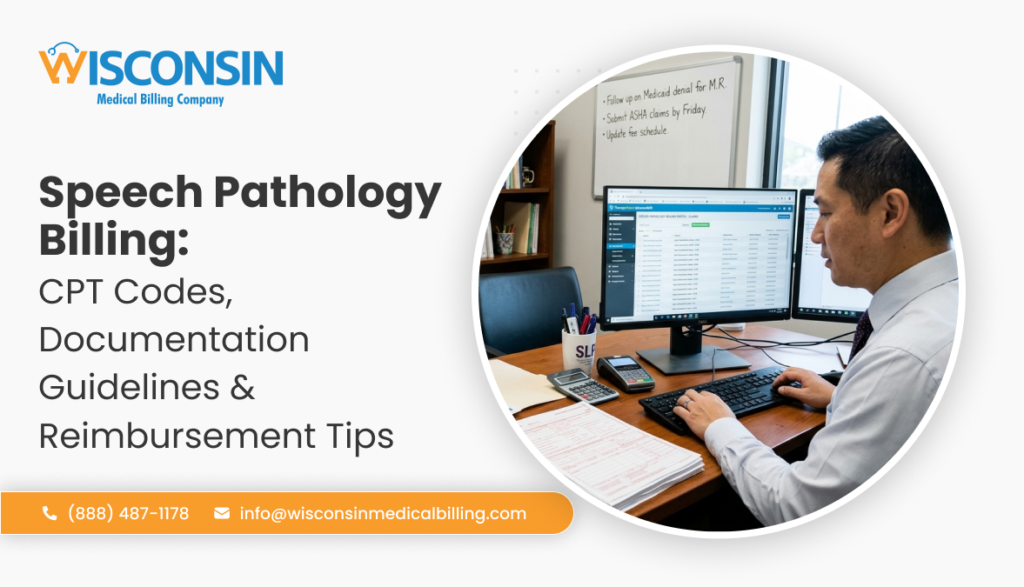
Speech pathology practices can help patients to improve their communication, speech, language, voice and swallow functions. In order to effectively manage the billing of speech pathology practices, providers will need to make sure they use the right codes, good documentation and ensure they can claim for the right cover.
Speech pathology can become complicated to bill for as there could be many different insurances, authorizations and treatments. If you get your codes wrong or don’t have enough documentation to back up your claim you could run into issues with getting your claims paid.
Knowing the CPT codes, medical necessity, and payments for speech pathology will help speech language pathologists maintain consistent billing. You could choose to use a professional speech pathology medical billing service to manage your claims, coding checks, denying and more.
This guide will show you common billing codes used for speech pathology, what documentation you’ll need, common errors and tips to improve reimbursements.
From Patient Visit to Claim Payment
A well-organized workflow helps speech therapy practices connect clinical care with accurate billing.
Verify Coverage
Check active benefits, network status, referrals, and applicable visit limits.
Review Clinical Notes
Confirm the evaluation, treatment delivered, goals, and clinical justification.
Prepare the Claim
Match documented services with appropriate codes, modifiers, and payer rules.
Track the Outcome
Monitor payer responses, post payments, and follow up on unresolved claims.
What is speech pathology billing?
Speech pathology billing is when you report services provided by speech-language pathologists to insurance companies and other liable parties. You’ll want to ensure you’ve got the right codes and documentation to back up your claims.
Speech-language pathologists (SLPs) may assess and treat patients who suffer from speech sound disorders, language disorders, stuttering, voice disorders and swallowing disorders.
When communication difficulties occur alongside a separately diagnosed behavioral or mental health condition, practices may also need to consider the applicable documentation and payer requirements for mental health billing.
Depending on the patient’s needs they may receive a range of services including assessments, one-to-one therapy, group therapy, swallowing assessments and communication device assessments.
All services will need to be coded correctly depending on what you’ve provided. The billing team will need to check what cover the patient has, if the provider is eligible, any authorizations and what rules the payer has.
An effective speech pathology billing process generally includes:
- Verifying patient eligibility and insurance benefits.
- Checking referral and prior authorization requirements.
- Reviewing clinical documentation and the treatment plan.
- Selecting appropriate CPT and ICD-10-CM codes.
- Applying required modifiers and claim information.
- Submitting claims within payer filing deadlines.
- Posting payments and investigating outstanding balances.
- Correcting rejected claims and appealing appropriate denials.
Practices that coordinate these steps can identify potential billing problems earlier and spend less time correcting preventable errors.
Common Speech Pathology CPT Codes
Speech language pathologists use the CPT codes to indicate the tests and therapies they administered. Depending on the service provided, clinical documentation, coding rules, and payer requirements, the billing team must select the correct code. Professional medical coding services can help practices maintain accurate CPT and ICD-10-CM coding.
Speech Therapy CPT Codes at a Glance
Choose a code based on the service actually performed, the documentation, and applicable payer requirements.
Individual Treatment
Treatment of speech, language, voice, communication, or auditory processing disorders.
Group Treatment
Group treatment for applicable speech, language, voice, communication, or auditory processing disorders.
Fluency Evaluation
Evaluation of speech fluency, including applicable assessments for stuttering.
Speech & Language Evaluation
Evaluation of speech sound production together with language comprehension and expression.
Swallowing Treatment
Treatment of swallowing dysfunction or oral function for feeding.
Swallowing Evaluation
Clinical evaluation of oral and pharyngeal swallowing function.
Here is a summary of common codes used for speech-language pathologists:
| CPT Code | Description | Common Application |
| 92507 | Individual treatment of speech, language, voice, communication, or auditory processing disorders | Individual speech-language therapy |
| 92508 | Group treatment of speech, language, voice, communication, or auditory processing disorders | Group speech-language therapy |
| 92521 | Evaluation of speech fluency | Assessment of stuttering or cluttering |
| 92522 | Evaluation of speech sound production | Assessment of articulation or phonological disorders |
| 92523 | Evaluation of speech sound production with language comprehension and expression | Combined speech and language evaluation |
| 92524 | Behavioral and qualitative analysis of voice and resonance | Assessment of voice and resonance disorders |
| 92526 | Treatment of swallowing dysfunction or oral function for feeding | Dysphagia and feeding-related treatment |
| 92610 | Evaluation of oral and pharyngeal swallowing function | Clinical swallowing evaluation |
| 92611 | Motion fluoroscopic evaluation of swallowing function using appropriate procedures | Instrumental swallowing assessment |
| 92607 | Initial evaluation for a speech-generating augmentative and alternative communication device | Evaluation for an AAC device |
| 92608 | Each additional 30 minutes of the applicable AAC device evaluation | Additional evaluation time when supported |
| 92609 | Therapeutic services for the use of a speech-generating device | Training and treatment involving an AAC device |
Rehabilitation providers who also need guidance on therapy evaluation and treatment coding can review our guide to physical therapy evaluation and treatment CPT codes.
This is only a guide for coding. Make sure you are using the latest and valid CPT codes. See what documentation is needed. See what rules the payer has.
How to Choose the Correct CPT Code
Identify the correct code based on your documentation. Use CPT 92521 for evaluation of fluency. Use CPT 92523 for evaluation of articulation, receptive and expressive language.
Don’t interchange codes. For example, CPT 92507 is for one-to-one treatment and CPT 92508 is for group treatment.
Don’t try to bill for multiple services even if you did multiple things during the session. Your documentation and coding rules should back up what you’ve billed.
For example, if you did a swallow assessment and treatment session, these would be different. Ensure you’ve documented what you did and followed the right rules for the payer.
Common ICD-10-CM Codes Used in Speech Pathology
Whilst the CPT codes will tell you what services were provided, the ICD-10-CM codes will tell you what diagnosis the patient has been documented with. This will help to keep your claim accurate.
Here are some examples of diagnosis codes that could be used:
| ICD-10-CM Code | Description |
| F80.0 | Phonological disorder |
| F80.2 | Mixed receptive-expressive language disorder |
| F80.81 | Childhood-onset fluency disorder |
| F80.9 | Developmental disorder of speech and language, unspecified |
| R47.01 | Aphasia |
| R47.1 | Dysarthria and anarthria |
| R47.89 | Other speech disturbances |
| R49.0 | Dysphonia |
| R13.10 | Dysphagia, unspecified |
These are just examples of different communication and swallowing disorders that could be present. The right diagnosis code will depend on what was documented and what ICD-10-CM rules are applicable.
If a patient has a phonological disorder documented they’ll need a different diagnosis code to someone having treatment for dysphonia or dysphagia. Don’t choose a diagnosis code just because it’s common to use with certain therapies.
Don’t use a symptom code if a more specific diagnosis has been documented. If there isn’t enough information in the documentation you may need to ask the treating provider for clarification.
Top Tip – Get the proper ICD-10-CM codes for the current fiscal year. Effective 1 October 2026, ICD-10-CM codes for FY 2027 will be utilized for the appropriate dates of service. Code always has to be checked to see whether it is billable and if there are any instructions.
Speech Pathology Documentation Requirements
Having good documentation will help you choose the right codes, ensure medical necessity and help with claim reviews. Even if you choose the right CPT code, you may have issues with getting paid if you haven’t got enough documentation.
Speech-language pathologists should have good documentation to show the patient’s condition, assessment findings, treatment goals, what was provided and how they responded to treatment.
Essential Documentation Elements
Depending on what service was provided and what the payer requires you may need:
- Patient history and diagnosis: Relevant clinical information and the condition being evaluated or treated.
- Evaluation findings: Assessment results, communication limitations, swallowing concerns, or other relevant clinical findings.
- Medical necessity: An explanation of why the service is appropriate for the patient’s documented needs.
- Plan of care: Treatment goals, planned interventions, frequency, and duration when required.
- Treatment details: The specific interventions performed during the encounter.
- Progress toward goals: Measurable findings or other appropriate evidence of the patient’s response to treatment.
- Provider identification: The treating professional’s credentials and other required identifying information.
- Signatures and dates: Required authentication and documentation dates.
- Time and units: Accurate time records when applicable to the service and billing rules.
Is Your Speech Therapy Note Claim-Ready?
Use this visual checklist to identify missing details before the billing team prepares a claim.
✓
✓
✓
✓
✓
✓
Can a reviewer understand why the service was needed, what the clinician did, and how the note supports the claim?
Checklist items vary by service and payer. Follow applicable documentation and coverage requirements.
Documentation should reflect the actual encounter rather than rely on copied language that no longer represents the patient’s condition.
Why Medical Necessity Matters
Medical necessity is an important factor when it comes to getting paid for speech therapy. Payers may look into whether what was documented, planned and provided supports what you’re claiming for.
For additional guidance on Medicare coverage, review the official Medicare speech-language pathology services coverage guidelines to understand the basic coverage requirements for medically necessary outpatient services.
Just having a diagnosis won’t mean you’ll get everything covered. Documentation must include the necessity of the service for the patient and how it linked to the patient’s condition.
If a patient is in regular speech-language therapy then progress notes should reflect the appropriate documentation of what was offered and how they responded. If there are changes to their condition or aspirations then this should be recorded in the documentation.
Having documentation will allow the billing staff to answer any questions and appeal appropriately if the payer has any questions.
Insurance Verification and Prior Authorization
In speech pathology billing, insurance verification is a key aspect. differing insurances may offer differing cover depending on therapy, age of patient, diagnosis, if provider is in-network and any limitations.
You need to check the patient’s insurance before treatment begins. Practices can streamline these administrative steps through professional medical billing services in Wisconsin that support eligibility verification, claims processing, and payer follow-up.
What Should Practices Verify?
A thorough eligibility and benefits review may include:
- Whether the policy is active.
- Whether speech-language pathology services are covered.
- Whether the treating provider participates in the insurance network.
- Whether a referral or prescription is required.
- Whether prior authorization is necessary.
- Whether the plan limits visits or treatment duration.
- Whether deductibles, copayments, or coinsurance apply.
- Whether the payer requires specific documentation.
- Whether telehealth services are covered under the patient’s plan.
Verification does not guarantee payment. Coverage and reimbursement are subject to all of the conditions of the plan, including medical necessity, as well as the claim details, and payer policy.
Because coverage and payment requirements can vary, providers can consult the official Medicare coverage of therapy services guide for information about outpatient speech-language pathology, physical therapy, and occupational therapy coverage.
Practices that coordinate care with psychiatric providers may also need to account for the separate billing and documentation requirements associated with psychiatry billing services.
How Authorization Problems Affect Reimbursement
Some plans will need pre-authorization for certain services. If this isn’t followed and completed by your practice this may result in the claim being denied.
Keep track of the authorizations including numbers, what they’re for, dates they are valid from, how many visits you’re allowed and when they expire. Speak to your healthcare team when you are getting close to your maximum number of visits.
Practices can make this easier by having a system to confirm eligibility and track pre-authorizations and claims.
Common Speech Pathology Billing Errors
Billing errors can cause unwanted administration and delays to receiving payments. It’s important to know what common errors are made so practices can put systems in place to avoid them.
Incorrect CPT Code Selection
If you use a coding system instead of a treatment code, or you aren’t quite sure about the difference between one to one and group treatments then this can cause confusion.
Always make sure to check that you have selected the correct CPT code for the treatment provided.
Diagnosis Codes That Do Not Match Documentation
If the code doesn’t match the clinician’s findings issues may arise with regards to medical necessity.
To avoid this, always check the diagnosis documented by the clinician and select the correct ICD-10-CM code.
Missing or Incomplete Clinical Notes
If there aren’t enough notes on the assessment, unclear treatment goals, incomplete progress notes, or no signature it can be hard to justify the services provided.
To avoid this, use clinical note checklists and review notes.
Authorization and Eligibility Errors
If the patient’s coverage has expired, the team hasn’t obtained the required pre-authorization, or the service exceeds the plan’s limits, the payer may reject the claim.
To avoid this, always check benefits and have a system in place to keep track of authorizations.
Incorrect Modifiers
Some payers will require the use of modifiers to identify which discipline; plan of care or other issue applies.
Generally, Medicare will require the GN modifier to show what services apply under the speech-language pathology plan of care. This will vary depending on the service, payer and current rules.
To avoid this, always check the correct modifiers needed for each payer.
Duplicate Claims and Filing Deadline Issues
If you don’t check the status of the claim and submit more than once this can cause duplicate claim rejections. If submitted late this can also affect receiving payment.
To avoid this, keep track of any claim acknowledgements, submission dates, payer responses and timely filing dates.
How to Improve Speech Therapy Reimbursement
Properly assigning CPT codes is only part of the solution to boosting payments. Having a consistent process in place to ensure the relevant information is gathered from the clinical notes to the insurance obligations will help.
Catch Billing Problems Before They Grow
Build consistent claim-review habits to help prevent avoidable rework and payment delays.
Common Risk Areas
Preventive Actions
A Simple Follow-Up Cycle
Review
Submit
Monitor
Resolve
Better process, clearer visibility. Review denial reasons regularly and correct recurring issues at their source. Reimbursement still depends on coverage, documentation, and payer rules.
Establish a Pre-Submission Claim Review
Make sure you have the right patient, clinician, diagnosis codes, CPT codes, modifiers, pre-authorizations and relevant documents.
This can help to identify any missing information before claims are rejected.
Track Denials and Identify Patterns
If you receive a denial, you should investigate why. If you’re constantly getting denied due to no authorization then you may need to improve your process for keeping track of authorizations.
Keep a record of reasons for denial, action taken, appeal dates and outcome. Regularly reviewing this can help to ensure you’re prioritizing any recurring issues.
For additional ideas on identifying recurring rejection patterns and improving claim follow-up, explore these data-driven denial management strategies.
Monitor Accounts Receivable
If claims aren’t being chased by the billing team you may run into cash flow issues.
Having a consistent A/R process will help to ensure you can see what claims are outstanding, what the payer has said, investigate any underpayments and escalate if required.
Keep Staff Updated on Coding Changes
CPT & ICD-10-CM codes can often change as can payers and coverage. Ensure you’re aware of any changes for the relevant codes, payers and coverage. Ensure your billing team are following the correct rules for the dates of service.
Having a consistent training process and regular audits can help to identify any coding issues.
Benefits of Professional Speech Pathology Billing Services
As your practice grows, adds clinicians, and works with more insurers, managing billing internally can become complicated. Specialized rehabilitation medical billing services can support speech therapy practices with coding, authorization tracking, claim submission, and denial follow-up.
A specialized billing partner can help with:
- CPT and ICD-10-CM coding: Reviewing codes against documented services and diagnoses.
- Eligibility verification: Checking insurance benefits before appointments.
- Authorization management: Tracking applicable approvals and visit limitations.
- Claims submission: Preparing and submitting claims within payer deadlines.
- Denial management: Investigating claim issues and managing appropriate corrections or appeals.
- Payment posting: Recording payments and reconciling account balances.
- Accounts receivable follow-up: Monitoring outstanding claims and pursuing unresolved payments.
- Reporting and analysis: Reviewing billing trends and recurring reimbursement problems.
While outsourcing won’t guarantee payment or that there won’t be any denials, having a consistent billing process can help clinicians identify any avoidable errors.
Why Choose Wisconsin Medical Billing?
We can assist healthcare practices with their revenue cycle. This includes rehab medical billing, medical coding, claims and denials.
Speech-language pathology practices will have specific coding and documentation requirements to ensure the correct information is captured. We can help with ensuring the right processes are in place to capture the right information based on the services provided, payer requirements and clinical notes.
Our team can help you to manage key billing requirements, double check claim details, keep track of outstanding balances and identify any issues with payments. Clinicians can find out more about our medical coding and rehabilitation billing services.
Whether you’re running an independent speech pathology clinic or multi-disciplinary rehabilitation practice having a consistent revenue cycle can help your team save time on admin issues.
Final Thoughts
Speech pathology billing requires accurate coding, clear documentation, benefit checks and consistent follow up. Knowing common CPT & ICD-10-CM codes can help to ensure the correct information is captured for the services provided.
However, having the correct coding won’t guarantee payment. Clinicians should follow payer rules, document medical necessity, obtain required pre-authorizations, and track outstanding claims.
If you need extra support with speech pathology medical billing, we can help maintain consistent coding checks, claims processing, denial management, and A/R follow-up.
If you’re looking for extra support with speech pathology medical billing, Wisconsin’s top medical billing company can help your practice manage coding checks, claims, denials, and accounts receivable more consistently. Get in touch with our team to discuss billing support suited to your practice’s needs. Get in touch with our team to find out how we can provide you with professional billing support.
Frequently Asked Questions About Speech Pathology Billing
What CPT code is used for speech therapy?
CPT 92507 covers individual treatment for speech, language, voice, communication, or auditory processing disorders, while CPT 92508 applies to group treatment. Always ensure you use the correct code for the service and payers.
What is the difference between CPT 92522 and 92523?
CPT 92522 is an assessment of articulation. CPT 92523 is an assessment of articulation, language comprehension and expression. Always ensure you select the correct code to match the assessment.
Does Medicare Require a Modifier for Speech Language Pathology Services?
Medicare generally require a GN modifier to be used for applicable services. Always check what the current requirements are for the service.
Is Everything Covered by Insurance for Speech Pathology?
No. It will depend on the patient’s plan, medical necessity, clinician eligibility, pre-authorizations, type of service and other factors. Always check benefits and payer requirements.
How Can Speech Pathology Practices Minimize Denials?
Always ensure you have done benefit checks, pre-authorizations, accurate coding, tidy documentation, pre-claim checks and chase denials quickly to reduce any avoidable issues.